Sunday, 22 September 2013

A Tribe Called Equestrian: How to DIY a Pixie Market Lace Horse Top

Just horsing around with the up -and-coming lace and applique trends!

You will need..


...and a sewing machine.

Difficulty

Easy

Well, I presumptuously say easy. It does involve sewing and requires a reasonably steady hand but if you've got those skills down, this one's a straightforward evening's-worth of a DIY.

Time

A few hours - I slacked off big time and was very distracted so I'd say 2-3 hours, tops.

Haute to trot...

Print out the horse template to A4 size, cut out the edges and cut the shape out twice in lace.
Craft mount the lace shapes to your sweatshirt.


Top-stitch satin binding along the edge and attach two 'manes' of fringing.

Sunday, 8 September 2013

Floral and Arty - How to DIY Valentino Floral Combat Boots

This year's famous floral trend has a winter garden aesthetic to boot!

You will need...

NB: For a scraper tool, I used a narrow wood carving knife but it doesn't have to be that specialised - a blunt scalpel will do.

Difficulty

Quite easy

It was fiddly in places but, while there was more to the process than first expected, I don't remember struggling with any of it. However, it does help to have a pretty steady hand!

Time

About 6-7 hours (I say that - a fair bit of mine was trial and error so it may not be as long as that).

Total cost

I used half a skin of leather I already had lying around so that would have been £10. The boots were £24.99 from H&M. I was actually lazy with sourcing - you can get combat boots for as little as £10 on eBay, or be even luckier with charity shops. Incidentally, I'd also recommend charity shops as a good place to get real leather; you can get good deals on bags and clothes, which you can then dissect. Either way, I digress - basically, I spent one respectable heck of a lot less than £995, which the original would set you back!

Just add flowers!

Cut out four of each of the following pieces in a similar size - the most relevant ones being 4 flowers measuring 8cm in diameter and 16 flowers which are 5cm wide. These are our bases, while the ones near the top will give different 3D textures.

If you're lucky enough to own a working printer, you might want to print out the above image as a template, which I think is about A3 size - apologies for my laughably poor maths if it isn't (God only knows how I got that A* at GCSE!).
Once you've cut all your pieces out, match the corresponding layers from the template and staple them together to make flowers. Then, get slightly overexcited when you see what your new masterpiece is starting to grow into with the 3D leather flowers perfected.


If you want to distress your flowers like those on the original, experiment by boiling them in water (yes, really) and tapping them with your hammer to smooth and soften the edges - not too hard, though. or you'll rip through them. You can also use your scraping tool to get some subtle textured finishes. If either of these parts scare you, you'll be pleased to know they're optional. You can also do as much or as little as you want so if you'd only like to do a few flowers, that's up to you.

Use your scalpel to pierce holes in your flowers and boots and secure them in place with split pins. You might also want to use the scalpel to prise out the remaining staples. Don't use staples to attach your flowers - I did, initially, and it didn't work! You may notice that I tinted the split pins black with some nail polish in the middle,for the sake of consistency.


Sunday, 1 September 2013

Cream of the Crop Tops - A strappy DIY

A strapping, young DIY inspired by the season's cut out crop top craze.

You will need...

Difficulty

Quite easy

To say this DIY is a total breeze might be tempting fate but I didn't find it especially hard.

Time

4-5 hours.

Total cost

Mine came to about £6 because I struck it lucky with the top!

Crop it like it's haute...


Turn your crop top inside-out. Fold it in half, across the front and pin all the seams and edges together, as much and as accurately as possible. Sketch out your design using something contrasting and opaque which doesn't rub off easily - I find metallic pens do the trick. Pin all the corners of your designs together - as shown in the picture - and use them as coordinates for tracing a perfectly symmetrical design on the opposite side. Repeat this process with the back.
Use your patternmaster, or graded setsquare, to trace out an outline 1cm outside each line, much like you would with a seam allowance - only here, there are no seams involved, or hemming, for that matter!
Cut out all your outlines and cut diagonally into the corners. I don't especially want to give the ending away but, basically, this makes folding easier.


Fold back all your edges, along the original outlines of your design, and iron them in place with Wonderweb. You can secure them even better by sewing inside the edges but this is optional.


Monday, 26 August 2013

Marc and Mirror - how to DIY a Marc by Marc Jacobs geometric necklace

Continuing the curb chain craze with a mirrored masterpiece from Marc.
Marc by Marc Jacobs Giant Gems printed silk and crystal necklace

You will need

N.B: Contrary to what the picture suggests, you will need a large slab of polymer clay in order to make your mirrored sections, or three normal-sized blocks in the same colour - I chose black.

Buy your jump rings in bulk - you can't have too many for this one. I got a pack of 100.

Difficulty

Moderate

I have no reason to lie here, this DIY did have its fiddly moments, although I wouldn't call it difficult.

Time

A full day - 6 or so hours, I think - but I wasn't really keeping track too closely, as one does when one's as pleasurably lost in a project as I was.

Total Cost

I don't usually go into detail in this particular category but this project was definitely more of an indulgence-motivated outing than a recycling or economical one. The total came to about £23 but, as those who know me will agree, I couldn't help myself. It's also a lot less than £202, which the original cost!

Get it in the necklace!

Fold your ribbons and chains in half, securing the latter in place by attaching your fastening at the tips, using your jump rings.

Tie each of your ribbons - at the centre - to the bases of your chains (the opposite ends to the clasps). Knot them twice.
Plait your ribbons and chains. The three sections should comprise two separate strands of ribbon and two chains together. Tie the ends of the ribbon as close to the end as you possibly can, cut away the excess ribbon and secure the edges with your glue gun to prevent fraying.
Cut 5 large pieces of clay about 0.5cm in thickness, wedge a pattern of mosaic tiles across the top and embed 4 jump rings at each side, apart for the two clap pieces that link to the chain - embed two jump rings for each of their corresponding sides. Ensure that your jump rings are well embedded with a loop sticking out, so that they don't get pulled out by the weight of the tiles.
Use your glue gun to secure the gems and diamantés in place.

Using pliers - or tweezers if your jump rings are especially small - link all your sections together via the extraneous jump ring loops.
Finally, secure your chain and ribbon sides in place, using the pliers and jump rings, as before.

Monday, 19 August 2013

Curb Chain Enthusiasm - How to DIY a Bijoux de Famille Pyramid Bow Necklace

Kicking it with the curb chain trend proved to be a "Famille" à faire!
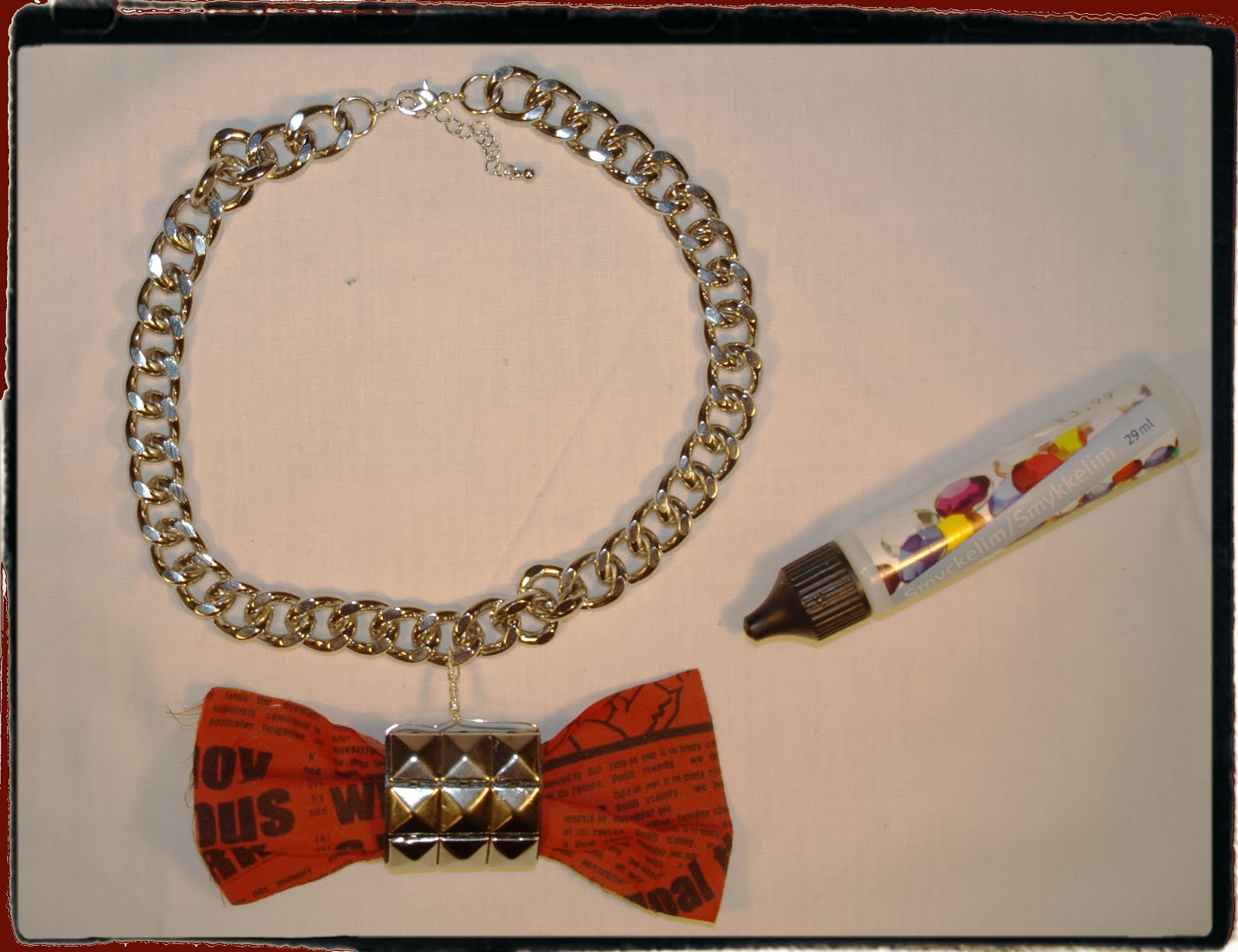
With punk's sartorial vitriol back in vogue and curb chains a staple season accessory I decided to combine the two and DIY the Pyramid Bow Necklace by Bijoux De Famille.

You will need


Difficulty

Pretty Easy

My gut instincts tell me I'd be wrong in listing this in the "Super Easy" category but I really can't think of anything too challenging in this one. There is one step that some people may find fiddly but, trust me, this one's nowhere near as hard as it looks.

Time

Mine took an hour and a quarter.

Total Cost

The cost varies a lot. I paid about £18 in the name of convenience but if you were to get the same fabric and cuff as I did on Ebay (which came to £ 4.50), as well as the fabric paint (about £3 depending on where you go), diamantés (priced at £2 with postage and packing included) and a chain (apparently priced at £1, if you're prepared to wait a few weeks for the delivery - I wasn't!) you can wangle the full ingredient list for just over a tenner.

Even if you find yourself forking out £20 it's still less than a tenth of the cost of the original, which is priced at £252!

Chain DIY action


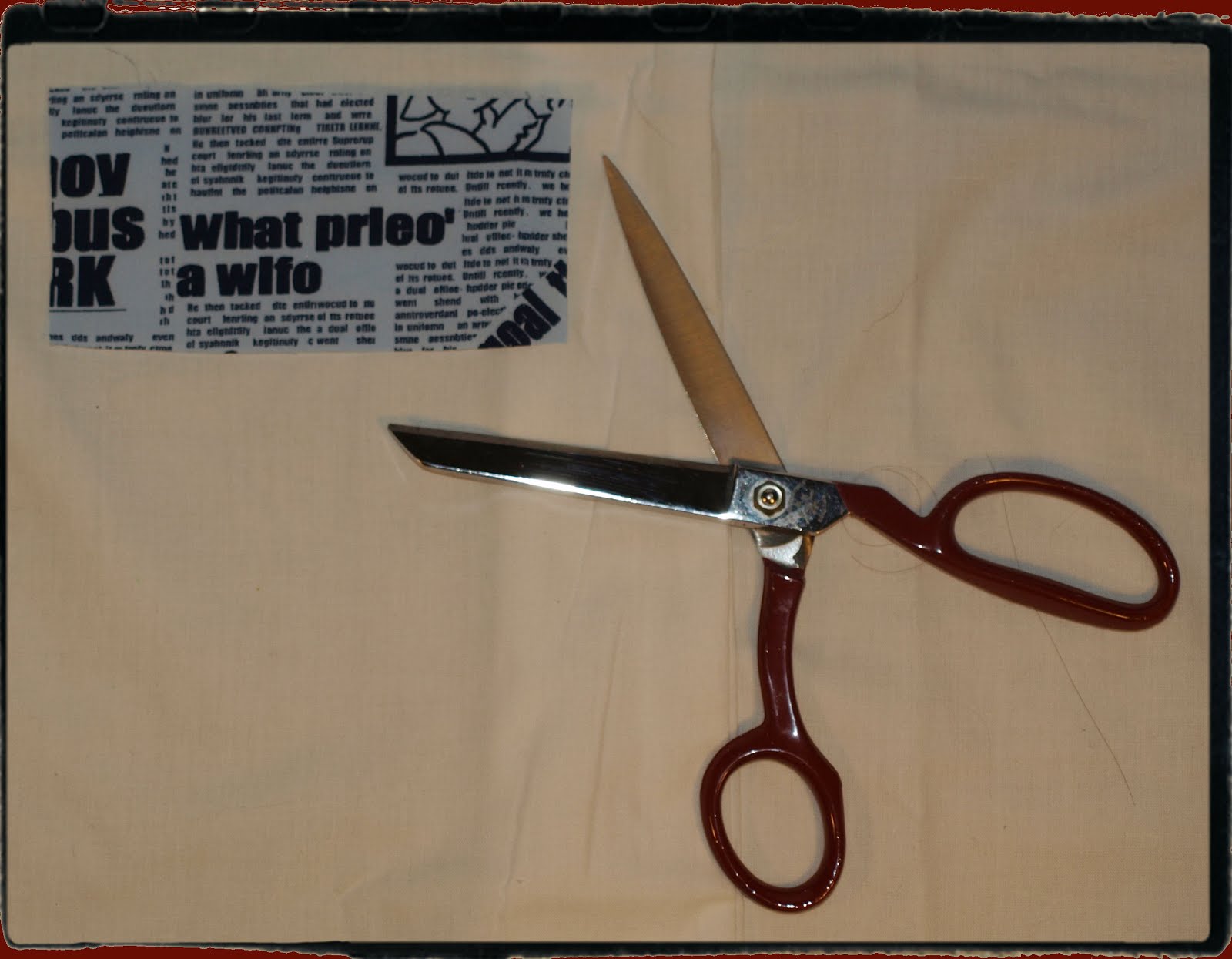
Cut a rectangle measuring about 6 x 15cm out of your newspaper print fabric.


If you do manage to find some red newspaper print fabric I'd like to first of all offer you my hearty congratulations and secondly ask where you got yours from. Failing that, simply paint yours red with a thin coat of fabric paint, like I did.

Meanwhile, with your cuff, remove all of your pyramid studs except a square area of nine, ideally near the middle.


Cut away the excess material on either side of the square so that there is enough for both sides to overlap when folded inwards but so much that it goes over the edge.


I used three of the left-over studs to secure the back bits in place.


Taking a small length of wire, thread it through the top of your new cuff, bend it back on itself so that it covers the top and bend each end upwards when it's halfway across. You should have two wires in the middle. Secure them in place by twisting them together with your pliers. Thread your wire through the middle link on your chain, bend the end into a loop and secure it with a final twist.


If your fabric needs stiffening, use clear car lacquer like I did - a fixative which, despite the name and intended purpose, is a fail-safe fixer I can't recommend enough.


Slot your fabric through the cuff and, making sure you've got the same amount on each side, secure it in place across the top with your gemstone glue.


Glue your diamantés along the edge and work the look!

Tuesday, 13 August 2013

Lim Beau - How to DIY a 3.1 Phillip Lim Resort 2014 dress

A recycled men's t-shirt packs a punch as a DIY 3.1 Phillip Lim dress from his Resort 2014 collection.

Image: Style.com

You will need... 


Difficulty

Moderate

Fiddly towards the middle. I say fiddly - if it weren't for the one process in question I'd rate it very easy. It helps to know your stuff when it comes to sewing elastic but if you don't, fear not for I will be your guide!

Time

About a day, i.e. 6-8 hours. Again, if it weren't for the process with the elastic it'd be significantly less. I don't want to give the ending away but the hole punching part was much quicker than expected.


Total Cost

The pliers cost about £12 from Hobbycraft, interfacing generally costs a few pounds, tops. For the t-shirt, you just have to be lucky with charity shops if you don't already have one hitherto in need of a new home - or makeover!

Lim Pickings


Use your graded setsquare (I used a patternmaster which does the same thing in this tutorial) to mark out 3 lines: a 45° diagonal line about 7cm from under the sleeves and a horizontal line just under the sleeves.


Pin your interfacing to your t-shirt as a reference and trace out 2 triangular pieces from below your diagonal line and a front and back piece from the shoulders to your top line. Cut them out.


Use your grid paper as a reference to trace out some perfectly geometric dotted patterns, as shown in the picture above, by placing it underneath your interfacing. It helps to have a well-lit work area!


Iron your interfacing in place and use your setsquare to measure parallel horizontal lines from 4 and 6cm under the bottom edge.


Now for the tricky part! Cut a length of elastic slightly longer than the circumference of your waist, or as much as you feel comfortable with, bearing in mind you'll need to be able sit down in the dress. Pin it along the top line, stretching it out until the ends meet ans sew it in place with a long, straight stitch along the middle - a tacking stitch which should be easy to unpick. To avoid snags and puckering take your time. If your sewing machine "eats" your fabric at all, simply unpick the stitches with a seam ripper and go over it. Use a small zigzag stitch across the top and bottom of the elastic, again, holding it under tension and stretched out, then unpick the tack stitching.


Use you eyelet puncher to create grid-like perforations through all your marked dots.


I tucked in the sleeves, fixed them along the armhole edges with a single row of stitches and cut away the excess fabric but that part's optional.